Tampilkan postingan dengan label Afghanistan. Tampilkan semua postingan

Desember 21, 2010

Photostream : Britain's Prince Andrew Visits Troops in Afghanistan


His Royal Highness the Duke of York (Britain's Prince Andrew) has visited the Helmand Provincial Reconstruction Team in Lashkar Gah as part of a visit to southern Afghanistan, December 19, 2010. During the visit, the Duke of York heard about the Team’s work, alongside British military effort, to support security and stability in the Province. Speaking about the visit, Mr Leo Tomlin, acting Deputy of Head of Mission at the Provincial Reconstruction Team said: "I know colleagues were delighted that the Duke of York was able to visit and hear about our work. The work being undertaken by civilians here, often in quite difficult conditions, continues to play a critical part in putting Helmand, and wider Afghanistan, on a secure and stable footing. The Duke was pleased to see the visible signs of steady progress across all areas of security, governance and development from when he visited last year."

The Duke of York (Britain's Prince Andrew), right,  made a surprise visit to British troops across Afghanistan (December 19, 2010) as more than 10,000 servicemen and women prepared to spend Christmas away from home. The Duke flew into Camp Bastion in Helmand province on Thursday evening and met personnel from the Fleet Air Arm, of which he is Commodore-in-Chief. After spending the night in Camp Bastion, the Duke viewed Apache, Merlin and Chinook helicopters with Lieutenant Colonel Mike Smith from the Joint Helicopter Force yesterday. He later visited the main field hospital at Camp Bastion. The Duke, who is Colonel-in-Chief of the Yorkshire Regiment, met soldiers and officers from the 2nd Battalion the Yorkshire Regiment, and watched a display of counter-IED (improvised explosive device) drills. 2nd Battalion the Yorkshire Regiment is currently in Afghanistan as part of an operation to help mentor troops from the Afghan National Army.

Rallying the troops: Among the places the Duke of York toured was the Sea King helicopter hangar in Camp Bastion, where he met personnel from the Fleet Air Arm and Royal Navy. The Duke of York donned full military gear as he flew into Afghanistan to rally the troops over the weekend. Wearing a beret and desert camouflage, Prince Andrew arrived in Camp Bastion, Helmand Province, on Saturday and stayed overnight at the base. His Royal Highness toured military bases on his brief trip, before meeting members of The Royal Irish Regiment and 2nd Battalion The Royal Regiment of Scotland.

Talking to the troops: The Duke of York meets Airmen from the 1419 Flight, Royal Air Force.

Desember 14, 2010

British Foreign & Commonwealth Office : Afghanistan monthly progress report


FILE : Britain's Prime Minister David Cameron (2nd R) smiles as he arrives at patrol base 2 between Lashkar Gah and Gereshk in Afghanistan December 6, 2010. Cameron, visiting Afghanistan on an unannounced trip, said troops could start withdrawing from the country as early as next year. Photograph taken December 6, 2010. REUTERS/ Leon Neal/Pool

 Please also visit : INDONESIAKATAKAMI.WORDPRESS.COM
December 14, 2010 (KATAKAMI / FCO.GOV.UK) --- The Foreign Secretary, on behalf of the Foreign and Commonwealth Office, the Ministry of Defence and the Department for International Development, has published a progress report on developments in Afghanistan. 


The Secretary of State for Foreign and Commonwealth Affairs (Mr William Hague):
 

I wish to inform the House that, today, the Foreign and Commonwealth Office, together with the Ministry of Defence and the Department for International Development, is publishing the first progress report on developments in Afghanistan, which I announced we would publish every month in my statement to the House on 27 October.

The report focuses on key developments during the month of November. 

At the NATO Lisbon Summit, the International Security Assistance Force (ISAF)’s 48 contributing nations reaffirmed their enduring commitment to Afghanistan’s security and stability.  NATO and Afghanistan also agreed the framework of a long-term partnership that looks beyond the end of ISAF’s current mission.  The Summit set out the timetable for transition of lead responsibility for security from international to Afghan forces by the end of 2014. 

Transition to Afghan lead security responsibility will be dependent on the conditions in each district and province.  It will see ISAF’s role evolve away from combat towards increased training, mentoring and support.  In Lisbon, ISAF partners joined the UK in pledging additional trainers to help Afghan security forces build capacity and prepare to assume lead responsibility for security, as set out at the Summit.

Pressure on the insurgency is increasing due to ISAF’s operations. The significant uplift in troop numbers has corresponded to an increase in military operations, particularly in those areas where insurgent activity is still strong, although this has not caused a significant increase in civilian casualties.   

Progress continues to be made in developing the Afghan National Army and the Afghan National Police, both of which are on track to meet the targets for trained soldiers and police officers, agreed at the London Conference in January this year, by November 2011. Investment continues in the training of both the army and the police, particularly their leadership. 

The results of September’s Parliamentary elections were declared. Whilst by no means free of irregularities or fraud, they were broadly credible, given the circumstances. Approximately 60 percent of Parliamentarians are new to the National Assembly. Female candidates have done well. Both of the two seats in Nimroz Province were won by women – the first time any Afghan woman has won a seat not reserved for a female candidate.

The Afghan Government reported progress on the commitments made at the Kabul Conference in July on security, anti-corruption, human rights and public financial management.

An important example of the region’s commitment to supporting Afghanistan was the fourth Regional Economic Cooperation Conference on Afghanistan (RECCA), held in Istanbul, Turkey on 2-3 November.  The UK was central to establishing the RECCA process in 2005, and this year funded the establishment of a Centre for Regional Cooperation at the Ministry of Foreign Affairs in Kabul.

A long awaited Afghan-Pakistan Transit Trade Agreement was finally signed by Afghanistan and Pakistan on 29 October, enabling cargo trucks to reach Pakistani ports and the border with India.  This will provide a significant boost for Afghan trade.

I am placing the Report in the Library of the House. It will also be published on the FCO website, and the HMG UK and Afghanistan website.   (*)

Desember 11, 2010

Attacks kill 22 civilians in Afghanistan

A U.S. military armored personal carrier vehicle passes by a damaged military check post after a suicide attack in Kunduz, north of Kabul, Afghanistan on Saturday, Dec. 11, 2010. A suicide bomber blew up a stolen police car that had been packed with explosives, injuring five Afghan soldiers and nine civilians near an army checkpoint in northern Afghanistan. (AP Photo/Fulad Hamdard)

An armored US military personal carrier passes by a damaged military check post after a bomb attack in Konduz on Saturday, Dec. 11, 2010.


December 11, 2010 (KATAKAMI / PRESSTV.IR) --- At least 22 civilians have lost their lives in a US airstrike and a roadside bomb blast in different parts of Afghanistan amid growing discontent over such attacks.


The US airstrike resulted in the deaths of at least seven people in eastern Afghanistan.

The Afghan employees of a road-construction company were the victims of the attack that took place in Zarmat district in Paktia Province.

Reports say locals have gathered at the site, expressing their anger over the attack.

The number of US-led airstrikes in Afghanistan has hit a record high. The US Air Force has released figures showing that in October alone, a total of 1,000 air raids were carried out across Afghanistan.

NATO and the US military claim the attacks target militants and their hideouts, however, such attacks often result in civilian casualties.

Civilian casualties and the deaths of Afghan security forces by so-called friendly fire have been a frequent source of tension between the Afghan government and foreign forces.

In a separate incident a roadside bomb killed at least 15 civilians, including children, in the southern province of Helmand. Four others were injured. The bomb hit the victims' pick-up truck in Khan Nashin district.

Meanwhile, a car bomb exploded outside the police headquarters in the city of Kandahar, wounding at least six people -- including four police officers.

Another bomb attack near an Afghan army base in Kondoz Province wounded at least 14 people, including nine civilians.

The bomber reportedly used a police vehicle recently stolen by militants.

US President Barack Obama recently admitted that the issue of civilian causalities had created tension between Washington and Kabul.

Obama has acknowledged that he sometimes has "blunt" conversations with his Afghan counterpart President Hamid Karzai, who has often criticized the US-led alliance for endangering civilians.

"Sometimes that conversation is very blunt. There are going to be some strong disagreements. Sometimes real tensions," the US president said at a NATO summit in Lisbon last month.

There are currently some 150,000 US-led soldiers stationed in Afghanistan.  (*)

Photostream : Bomb explodes in Afghanistan


Afghan traffic officers check the engine which is all that remained of the vehicle used in a car bomb explosion, beside a damaged vehicle, after an explosion in Kandahar south of Kabul, Afghanistan on Saturday, Dec. 11, 2010. A car bomb exploded outside a police headquarters in Kandahar, wounding at least six people and blowing out the windows of buildings up to a mile (1.6km) away, officials said. (AP Photo/Allauddin Khan)

An Afghan police man stands near damaged police vehicles after an explosion in Kandahar south of Kabul, Afghanistan on Saturday, Dec. 11, 2010. A car bomb exploded outside a police headquarters in Kandahar, wounding at least six people and blowing out the windows of buildings up to a mile (1.6 km) away, officials said. (AP Photo/Allauddin Khan)

An Afghan police man inspects in side of a damaged vehicle after an explosion in Kandahar south of Kabul, Afghanistan on Saturday, Dec. 11, 2010. A car bomb exploded outside a police headquarters in Kandahar, wounding at least six people and blowing out the windows of buildings up to a mile (1.6 km) away, officials said. (AP Photo/Allauddin Khan)
A U.S. military armored personal carrier vehicle passes by a damaged military check post after a suicide attack in Kunduz, north of Kabul, Afghanistan on Saturday, Dec. 11, 2010. A suicide bomber blew up a stolen police car that had been packed with explosives, injuring five Afghan soldiers and nine civilians near an army checkpoint in northern Afghanistan. (AP Photo/Fulad Hamdard)

November 25, 2010

Opinion : Why not leave Afghanistan tomorrow?


US President Barack Obama gestures as he speaks during a press conference on November 20, 2010 in Lisbon, as part of a NATO (North Atlantic Treaty Organization) Summit of Heads of States and Government held on 19-20 November 2010. (Photo by PIERRE-PHILIPPE MARCOU/AFP/Getty Images)

 
By : Ed Koch ( Jpost )


November 24, 2010 (KATAKAMI / Jpost) --- President Barack Obama met with his NATO counterparts in Lisbon last week.  According to the November 21 New York Times, they agreed “to the goal of a phased transfer of security responsibility to the Afghan government by the end of 2014, but NATO officials acknowledged that allied forces would remain in Afghanistan at least in a support role well beyond that date.”

Further, if the Afghan army isn’t ready by the end of 2014 to “manage its own security, 2014 was not a hard and fast deadline for the end of combat operations.”  Why would anyone think that Afghan forces will ever be combat ready and able to defend their own country against the Taliban? Surely it is by now an unsolvable mystery why the Afghan military forces, trained for 9 years by US and NATO troops, is currently unable to defend their country while the Taliban is capable of major successful strikes in Kabul, the capital, and apparently governs large parts of the country either by night when US army patrols return to their bases, or 24 hours a day when US forces don’t dare enter the neighborhood.

 We know that the Taliban is supplied with substantial funding from the local drug trade.  We know that drug trade is dominated by the Karzai family, and that President Karzai’s own brother, Ahmed Wali Karzai, is acknowledged to be a drug kingpin.  We know that Afghanistan is one of the most corrupt countries in the world.  We know that Iran regularly sends millions of dollars to President Karzai for his personal use.  We know all of these things because The New York Times reporters day after day, week after week, year after year, have reported how the Karzai government has cooperated with the Taliban forces seeking to bring them into the Afghan government.  Bizarrely, the US government has cooperated with those efforts, while our soldiers die in the killing fields of Afghanistan.

In June of this year, the Wall Street Journal reported:

“More than $3 billion in cash has been openly flown out of Kabul International Airport in the past three years, a sum so large that US investigators believe top Afghan officials and their associates are sending billions of diverted US aid and logistics dollars and drug money to financial safe havens abroad.  The cash -- packed into suitcases, piled onto pallets and loaded into airplanes -- is declared and legal to move.

But US and Afghan officials say they are targeting the flows in major anticorruption and drug trafficking investigations because of their size relative to Afghanistan's small economy and the murkiness of their origins.  Officials believe some of the cash, if not most, is siphoned from Western aid projects and US, European and NATO contracts to provide security, supplies and reconstruction work for coalition forces in Afghanistan.

The North Atlantic Treaty Organization spent about $14 billion here last year alone.  Profits reaped from the opium trade are also a part of the money flow, as is cash earned by the Taliban from drugs and extortion, officials say.  The amount declared as it leaves the airport is vast in a nation where the gross domestic product last year totaled $13.5 billion.  More declared cash flies out of Kabul each year than the Afghan government collects in tax and customs revenue nationwide.  ‘It's not like they grow money on trees here,’ said a US official investigating corruption and Taliban financing.  ‘A lot of this looks like our tax dollars being stolen. And opium, of course.’”

We also know that President Karzai endangers American and other NATO troops (we have about 100,000 troops in Afghanistan while the rest of NATO has 40,000) by demanding according to The Times, “that the NATO led coalition stop carrying out night raids and limit airstrikes, which military commanders consider among their most effective tools but which have caused civilian casualties."

President Obama in response to Karzai’s demands that the US limit its military responses said, “If we’re ponying up billions of dollars to ensure that President Karzai can continue to build and develop his country, then he’s got to also pay attention to our concerns as well…He’s got to understand that I’ve got a bunch of young men and women who are in a foreign country being shot at” and “need to protect themselves.”

Nevertheless, despite his protestations, our young men and women continue to die to protect a corrupt government and country where many people hate us.

The Times reported on November 21 that “At a closed door meeting here, General David H. Petraeus, the top American and NATO commander in Afghanistan, set out his strategy for the transition, confirming that the kind of operations Mr. Karzai has criticized, including drone missile strikes and nighttime raids would continue aggressively.”

If the Afghan government persists in denouncing and objecting to our tactics, I have no doubt that they, not we, will prevail.  Our being in Afghanistan and the way we conduct ourselves is subject to his approval.  We have said many times that we will leave Afghanistan whenever and if ever the Afghan government demands we do.  Why should they ever demand we leave?  We are their piñata.  The US obviously doesn’t want to leave.  To date, we have spend over $300 billion on the Afghan war and we have suffered 1,273 US troop deaths.  NATO has suffered 822 troop deaths.  We have suffered over 7,000 combat injuries.  Those injuries are the worst kind, coming primarily from Improvised Explosive Devices (IEDs) roadside bombs, causing many amputations and brain injuries.

What do we have to show at this point for the bloodbath we have suffered and the billions we have expended?  We are hindered in defending ourselves by a corrupt Afghan government with a particularly corrupt Afghan President playing a double game with our sworn enemy, Iran.  The latter sees Afghanistan as a satellite tribal area to be bought not only with Iranian bribes, but also with religious and ethnic ties.

Afghans know that Iran will be there forever, while the US will ultimately leave if not tomorrow, and not in 2014, sometime in the future when ultimately a now apparently lethargic American public finally wakes up and demands we leave.  We would have left long ago were we still defended by a draft army instead of a volunteer army.

Surely, the combination of spilled blood with the expenditure of billions of dollars on the war in Afghanistan, when we are now contemplating reductions in Social Security benefits and educational funds for teaching our children, will cause the American public to rise up in wrath and say “No,” with a mighty roar.  The question of remaining in Afghanistan, while not even an issue in the 2010 election, will become one in the presidential election of 2012.

Why this ongoing stupid war which cannot be won on the ground because there is nothing worth winning has not received the attention that it deserves from the American public is a conundrum.  Nevertheless, the American public, even if at times it acts too slowly, will ultimately act.  Getting out of Afghanistan now, not in 2014 or thereafter, is the right thing to do.  (*)

November 21, 2010

A transcript of PM David Cameron’s press conference at the NATO Summit in Lisbon


British Prime Minister David Cameron gives a press conference at the end of a NATO summit in Lisbon on Saturday Nov. 20, 2010. NATO on Saturday delivered a historic invitation for Russia to join a missile shield protecting Europe against Iranian attack, a milestone for an alliance that was built to defend against Soviet forces.(Getty Images / AP Photo/Markus Schreiber)

Please also visit : INDONESIAKATAKAMI.WORDPRESS.COM


November 20, 2010 (KATAKAMI / NUMBER 10.GOV.UK) --- Prime Minister David Cameron : Good afternoon.  NATO remains the bedrock of our collective defence and it is the most successful alliance in history: it has kept Europe secure for 61 years.  Whether we’re talking about conventional forces, our nuclear deterrents or how we defend ourselves against new threats, it is only NATO that brings Europe, the United States and Canada together.  My interventions this weekend were focused on NATO’s future, the next steps in Afghanistan, the reform of NATO for the 21st century and our partnership with Russia.

First, Afghanistan.  All 48 ISAF nations today reaffirmed our enduring commitment to a mission that is crucial to our national security, and we agreed today to enter a new phase in the campaign.  Our declaration sets out a clear commitment that transition will begin in early 2011.  We also reaffirmed our support for President Karzai’s objective for the Afghan national security forces to lead and conduct security operations in all provinces by the end of 2014.  This is not a commitment we have made lightly.  All 48 members of the ISAF coalition are agreed.  I know from meeting him today that President Karzai is agreed; so is the Secretary General of the United Nations.  So this is a commitment made at the very highest level with the broadest possible international support.  We also committed today to a long-term relationship with the government of Afghanistan.  Through training, diplomacy and development we will stand by Afghanistan for many years to come.

Britain has been at the centre of this debate.  We are the second largest contributor to ISAF with around 10,000 troops risking their lives in the most dangerous parts of Afghanistan.  I salute their bravery and their sacrifice.  By putting their lives on the line they are making lives safer back in Britain.  The commitment we’ve entered into today to transfer the lead responsibility for security to the Afghan government by the end of 2014 will pave the way for British combat troops to be out of Afghanistan by 2015.  This is a firm deadline which we will meet.

At this summit we also agreed on radical reforms to make NATO fit for the security challenges of the 21st century.  NATO’s new strategic concept reflects the thinking we set out in our National Security Strategy.  We will gear up to deal with the new threats: counterterrorism, cyber security, failing states, and the proliferation of weapons of mass destruction.  These are NATO’s key tasks for the years ahead.  Nuclear deterrence also remains at the heart of what the alliance is about, but I also want to see progress towards a world free from nuclear weapons, so I praise the courage that President Obama and President Medvedev have shown in agreeing a new START treaty; early ratification would be in all our interests.

Reform of NATO must also mean a more efficient NATO, and we made very good progress on this agenda too.  We will cut the number of command posts from 13,000 to less than 9,000; we will reduce the number of NATO agencies from 14 to three; and we will ensure that all decisions taken at this summit are funded from within NATO’s existing resource plan.  These changes will save Britain tens of millions of pounds and will allow NATO to focus its efforts on the frontline.

There was a discussion at the summit on cooperation between the EU and NATO.  It is, frankly, intolerable that a tangle of bureaucracy in Brussels is preventing practical cooperation on the ground in Afghanistan.  We need to find a way through this as quickly as possible.

As you know, there’s also been a major breakthrough at this summit on missile defence.  Not only have we agreed, for the first time, to establish a missile defence system to protect all NATO members from ballistic missile attacks, but we’ve also taken the unprecedented step of inviting Russia to cooperate with us on that system.  Just a year ago, missile defence was a deeply divisive issue in NATO and in NATO Russia relations.  Today, that same issue is bringing us together, demonstrating that we can and will cooperate with Russia on our vital security interests.  At a time when we face an increasingly grave threat from rogue states with countries like Iran seeking to develop ballistic missile capabilities, these are significant, bold, and necessary steps.

Let me finish by congratulating Secretary General Rasmussen for his outstanding leadership.  In 1949, the alliance first said that an attack against one is an attack against all.  Today, the threats we face are different and the world is in many ways more uncertain, but our alliance remains rock solid and Britain’s commitment to it is as strong as ever.

Thank you, and happy to take some questions.


United Kingdom's Prime Minister David Cameron speaks during a press conference on November 20, 2010 in Lisbon, as part of a NATO (North Atlantic Treaty Organization) Summit of Heads of States and Government held on 19-20 November 2010. (Photo by MIGUEL RIOPA/AFP/Getty Images)

Question

Thank you, Prime Minister.  Is it responsible to set a date for the withdrawal of combat troops irrespective of the situation on the ground?  You’ll be aware your NATO counterparts say that conditions not calendars should determine the withdrawal.

Prime Minister

Well, NATO has itself set a timeline of 2014 by which time transition will be complete and Afghan forces will be in lead control.  The deadline we’ve set, 2015, is beyond that and it is, if you like, a backstop, but let me be clear: it is a deadline, and I think the British public deserve a deadline.  By 2015, we will have been in Helmand Province, the toughest part of Afghanistan, for nine years.  We have 10,000 troops; that is the second largest participation after America.  We’ve paid a very high price in terms of the service that our service personnel have given and the lives that we have lost.  We’ve played a great role in making Afghanistan a stronger and more stable country, and I think it’s only right that we are clear with the British public that there is an endpoint in this work, and it’s an endpoint that is totally consistent with what NATO and the Afghan government have set out.

Question

Prime Minister, can we just be absolutely clear: if, after 2014, you receive a request from either NATO or, indeed, the Afghan government to provide British troops for combat operations in Afghanistan, you will turn it down?  I suppose what I’m asking is, given that the Americans have left that particular door open, why have you been so quick to close it?

Prime Minister

Well, I think that the British people deserve this sort of clarity, and let me be clear: we will go on having a relationship with Afghanistan.  We will have a development relationship, we will be spending aid money in Afghanistan, we’ll have a diplomatic relationship, we’ll have government to government relations, we may have British soldiers helping to go on training their armed forces, which will be essential for the stability of Afghanistan.  But what I’ve said is that from 2015 there won’t be troops in anything like the numbers there are now and there won’t be combat troops.  That is completely consistent with what NATO’s set out, but I think the British public need to know that after having gone into Afghanistan in 2001, having gone into Helmand Province in 2006, having taken such a huge share of the burden, having performed so magnificently all these years, that there is an endpoint, there is a deadline, and that is what I’ve set, totally consistent with what NATO and the Afghan government have set out, but I think absolutely right that we do that.

Question

You say it is consistent with what NATO are saying, but the Secretary General Rasmussen was saying it had to be conditions-based; it could not be calendar-driven.  You are talking about a deadline.  There is a clear difference, isn’t there, there?


German Chancellor Angela Merkel, French President Nicolas Sarkozy and British Prime Minister David Cameron talk prior to participation in a NATO Russia Council meeting at a NATO summit in Lisbon on Saturday Nov. 20, 2010. NATO planned Saturday to deliver a historic invitation for Russia to join a missile shield protecting Europe against Iranian attack, a milestone for an alliance that was built to defend against Soviet forces.( Getty Images / AP Photo/Armando Franca)


Prime Minister

Well, I do not accept that there is a difference, because NATO is saying that between early 2011 and 2014, transition will take place, and by 2014, what you will have is the Afghans in lead security control throughout Afghanistan.  When I set this deadline, I set it beyond that mark, but I think it is important, as I say – and the British public have been incredibly supportive and very, very supportive of our brave armed forces and what they do, but I think they deserve to know that there is an endpoint, that this does not go on for ever in terms of a combat mission.

But let me be clear.  We will go on having a relationship with Afghanistan.  We will not walk away from that country, but by 2015, we will have done many, many years in Helmand province, the toughest part of Afghanistan, and I think the British public deserve that sort of certainty about the future.

Question

Just following through on what you have said: 2015 is a deadline you will end British combat operations in Afghanistan, come what may.  We do not know the US position on that.  Would you be willing, as a British Prime Minister, to withdraw British troops from combat operations in Afghanistan if American troops were still engaged in combat?  Would you leave our closest ally fighting alone in Afghanistan?

Prime Minister

We are working extremely closely with our closest ally, and we will go on doing that, but as I have said, I could not be more clear about what 2015 is and what it means.  I mean, let’s be clear: there are other countries that have already moved from combat operations to training missions.  By 2015, we will have spent nine years in Helmand, the toughest part of Afghanistan.  We have already paid a very high price.  We go on paying that price.  We know that we have an important role in bringing the stability and security, which is good for the whole of the world, and good for Britain, because we still face an Islamic terrorist threat that comes out of the Afghanistan-Pakistan region, and we have to squeeze that problem from both sides of the border, as we are doing, but I have been absolutely clear about the commitments that we have made and will make.

Question

Are there any commitments in place to ensure that other NATO nations will remain with the combat mission right to the end, and not just leave Britain and America to wash up in the most difficult places?  And what scale of commitment beyond 2015 to the combat mission are you prepared to make?

Prime Minister

Okay, well, two questions there.  First of all, on the issue of as we transition, I think it is important that those countries that are involved in easier parts of the country do not just transition, as it were, over and out, leaving countries like Britain in some of the more testing parts of the country.  I discussed that in my contributions to the ISAF summit here, and President Obama, I know, shares those views; we discussed it.  I think it is important that those countries that are able to benefit from transition early on reinvest into training or into other parts of the country.  This is an alliance of solidarity.  It is important we show that sort of solidarity.

In terms of the future beyond 2015, it is some way away, and I think it is quite a speculation about how many troops would be involved in, for instance, ongoing training of the Afghan army.  But obviously that is something Britain does extremely well, Britain is very involved in that now, and that is something I think, in terms of building the capacity of Afghanistan to go on looking after its own security, is something that may well be in our interests to make a decent sized contribution to.

Question

Prime Minister, as you are aware, there was a degree of resentment among the Americans when the British pulled out of Basra against the wishes of many of the American commanders.  Do you think there may be a similar kind of reaction among the Americans if we pull out of Helmand in a combat role while they are still fighting in Southern and Eastern Afghanistan?

Prime Minister

I just do not sense that at all.  I have spent the last two days sitting next to President Obama at virtually every meeting and virtually every meal, and the relationship between Britain and America, and the cooperation of our forces, and the fact that they are fighting alongside so effectively, I think, is extremely strong.  We are the second largest contributor in Afghanistan, ten thousand troops in the toughest part of the fighting, absolutely, and if you go to Helmand, you see British troops and US Marines working hand-in-hand, side by side, fighting incredibly effectively.  And I think the Americans respect and know that the British forces are forces capable of taking the fight to the enemy, of closing with the enemy and, actually, full combat, no caveat, and equally as effective as any troops anywhere in the world.

So I do not really recognise the overall description, but I think the most important thing is to set out these positions clearly.  That is exactly what I have done and what I have gone on doing today.

Question

Are you able to say whether we are going to start withdrawing troops next year, and can you indicate which districts in Helmand you envisage as being the first ones to be able to be transitioned to Afghan lead?

Prime Minister

I think it would be wrong to try and identify districts.  I mean, the process is that we have agreed at this NATO summit that transition will start in 2011, early 2011.  What now has to follow is a plan and a process that needs to be based on the conditions on the ground about what can be transitioned and when.  Clearly, if it starts in 2011, there should be opportunities for countries to move troops from combat to training or, indeed, to possibly even reduce troop numbers in some way, so these are possibilities that will be examined as the NATO plan is drawn up.  We will play a very clear and important role in that.  As I say, if you look at the role that Britain plays, the second largest troop contributor, involved in the toughest part of the country, absolutely at the heart of NATO, at the heart of the ISAF command where we have the Deputy Com ISAF, absolutely the centre of that process and so involved in both the shaping and the planning of it as well as the execution, and, indeed, as you have indicated in your question, being a beneficiary from that process as well.

Can I thank you all very much for coming and wish you a safe journey home.  Thank you.  (*)

“Firm deadline” for UK troop withdrawal from Afghanistan, says PM Cameron

British Prime Minister David Cameron speaks to the media during a press conference on day two of the NATO summit at Feira Internacional de Lisboa (FIL) on November 20, 2010 in Lisbon, Portugal. The two day summit will address issues including a new strategic concept for NATO. Britain and the US will also seek an agreement to hand over responsibility for security in Afghanistan to local forces over the next four years. (Photo by Peter Macdiarmid/Getty Images)

Please also visit : INDONESIAKATAKAMI.WORDPRESS.COM

November 20, 2010 (KATAKAMI / NUMBER 10.GOV.UK) — Prime Minister David Cameron has said the withdrawal of British combat troops from Afghanistan by 2015 was a “firm deadline” that would be met.

Speaking at the close of the NATO Summit in Lisbon, the PM said Afghan forces would begin taking charge of security from early next year.

Transcript: Press conference at NATO Summit

He said the process would be complete by the end of 2014 allowing British troops to step back from combat roles by 2015.
“The commitment we have entered into today to transfer the lead responsibility for security to the Afghan government by the end of 2014 will pave the way for British combat troops to be out of Afghanistan by 2015,” he told an end-of-summit press conference.
“This is a firm deadline that we will meet.”
Mr Cameron’s comments come after leaders of NATO’s 28 states backed a strategy to transfer leadership for the fight against the Taliban to Afghan forces by the end of 2014.

Afghanistan President Hamid Karzai attended the Summit, where he signed a long-term security partnership with NATO.

Mr Cameron hailed today’s agreement as the beginning of a “new phase in the campaign”.
“This is a commitment made at the very highest level, with the broadest possible international support.”
While UK forces would no longer be involved in combat duties by 2015, Mr Cameron said NATO had also agreed to provide long-term support for Afghanistan on training, diplomacy and development.
“We will stand by Afghanistan for many years to come.”
On Friday member states agreed a new 10-year “strategic concept”, a document that defines the fundamental nature of NATO’s role in the world.

The document commits NATO members “to defend one another against attack, including against new threats to the safety of our citizens”, without defining a geographical limit to its theatre of operations.
Also at the Summit, Russia agreed to co-operate on NATO’s programme to defend against ballistic missile attacks.

NATO Secretary General Anders Fogh Rasmussen said the two sides had agreed in writing that they no longer posed a threat to one another.  (*)

NATO aims to end combat mission in Afghanistan by 2015


Afghanistan's President Hamid Karzai (2nd L) and NATO Secretary General Anders Fogh Rasmussen (R) sign accords in front of U.N. Secretary General Ban Ki-moon during the NATO Summit in Lisbon November 20, 2010 (Photo : Reuters / Yves Herman)
Please also visit : INDONESIAKATAKAMI.WORDPRESS.COM

November 20, 2010. (KATAKAMI / Reuters) - NATO agreed on Saturday to hand control of security in Afghanistan to Afghan forces by the end of 2014 and said the NATO-led force could halt combat operations by the same date if security conditions were good enough.


Some NATO officials fear a rise in violence could make it hard to meet the target date set by Afghan President Hamid Karzai for the security handover, which would leave a vastly reduced number of foreign troops in a training and support role.

But President Barack Obama lifted hopes the target date would be met by saying for the first time that his aim was to halt major U.S. combat operations by the end of 2014 and significantly reduce the number of U.S. troops there.

"Today marks the beginning of a new phase in our mission in Afghanistan," NATO Secretary-General Anders Fogh Rasmussen told an alliance summit in Lisbon attended by the Afghan president and 48 countries with troops in Afghanistan.

"I don't foresee ISAF (International Security Assistance Force) troops in a combat role beyond 2014, provided of course that the security situation allows us to move into a more supportive role."

Senior U.S. officials had raised doubts about the target for the end of combat operations, saying Obama would decide when the U.S. combat mission ends only after completed a review of the war. But the president later said he shared the NATO aim.

"My goal is to make sure that by 2014 we have transitioned, Afghans are in the lead, and it is a goal to make sure we are not still engaged in combat operations of the sort we are involved in now," Obama told a news conference.

Karzai said he also believed the handover, starting early next year, could be completed by the end of 2014 "because I found today strong commitment by the international community."

United Nations Secretary-General Ban Ki-moon said, however, the handover must be shaped by the security situation and not by timetables. "There are no short cuts to peace," he said.

PRESSURE ON OBAMA

Obama said counter-terrorism operations against al Qaeda in the region were likely to continue after 2014. About 90,000 of the 130,000 ISAF troops are American and there are more than 20,000 other U.S. soldiers based in Afghanistan.

Rasmussen said the new strategy did not mean all 150,000 foreign troops in Afghanistan would leave by the end of 2014 and said NATO would not abandon the government.

"If the enemies of Afghanistan have the idea that they can just wait it out until we leave, they have the wrong idea," he said.

The Afghan conflict is widely seen as going badly for the United States and NATO. Obama was stung by criticism last year that he was jeopardizing the lives of U.S. soldiers by announcing U.S. troops would begin withdrawing in July 2011.

Critics said setting the date would embolden the Taliban and the White House had been careful to refer to 2014 only as the date when Afghans would finally take the lead in security rather than as a target for the end of the U.S. combat mission.

Many countries' leaders face voter pressure to withdraw troops gradually as casualties and costs rise.
Western casualties this year have hit record levels and in the latest attack Taliban suicide bombers on bicycles killed four people and wounded 31 on Saturday.

Despite the problems, Obama, who ordered 30,000 more troops to Afghanistan last year, said he believed NATO forces were making progress in blunting the momentum of the Taliban.

Security analysts, however, have questioned the upbeat assessments of U.S. military officials, saying they appear designed to influence U.S. public opinion.

STRATEGY FRAUGHT WITH DIFFICULTIES

The U.S.-led intervention in Afghanistan began in response to the September 11, 2001, attacks. The United States and its allies invaded to overthrow the then-ruling Taliban, who had refused to hand over al Qaeda leader Osama bin Laden.

More than 2,200 foreign troops have since been killed there. The withdrawal strategy hinges on efforts to build up Afghan forces so they can contain the insurgency.

The Kabul government is widely seen as too corrupt, unstable and inept to survive long without foreign military support.

NATO enlisted the support of Russia during talks in Lisbon with President Dmitry Medvedev, whose country is not part of NATO and was its Cold War enemy.

Medvedev agreed to expand an agreement to allow equipment to go through its territory to Afghanistan and agreed to look at ways for Russia be involved in a U.S.-European missile defense system designed to protect against a long-range attack.

Thousands of anti-NATO protesters marched peacefully through Lisbon on Saturday and police detained several dozen activists who blocked a road to the military alliance's summit venue. There were no reports of violence.  (*)

Oktober 27, 2010

We've been in Afghanistan, we didn't like it - Russia's NATO envoy


We've been in Afghanistan, we didn't like it - Russia's NATO envoy

October 27, 2010 (KATAKAMI / RIA NOVOSTI) --- Russia's envoy to NATO on Wednesday dismissed reports that Russian troops could be sent back to Afghanistan two decades after the Soviet Union's Red Army was forced out by U.S.-backed mujahedeen.

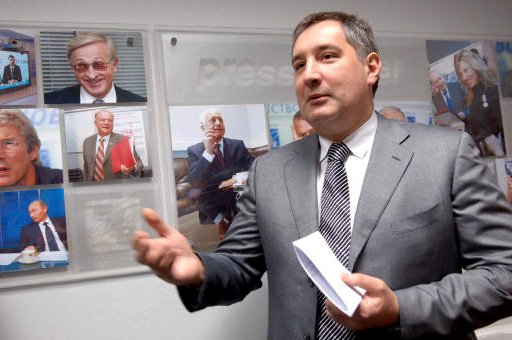
"We've already been in Afghanistan and we didn't like it much," Dmitry Rogozin told RIA Novosti.
The UK newspaper The Guardian said on Tuesday the proposal was on the table ahead of a landmark Russia-NATO summit in Lisbon next month.

The paper said Moscow and Brussels were discussing joint initiatives including "the contribution of Russian helicopters and crews to train Afghan pilots, possible Russian assistance in training Afghan national security forces, increased co-operation on counter-narcotics and border security, and improved transit and supply routes for NATO forces."

"Maybe someone wants Russia to supply cannon fodder to Afghanistan," Rogozin went on.

The Soviet Union was involved in a bitter decade-long conflict in Afghanistan from 1979 to 1989. A million Afghan civilians and fighters are estimated to have lost their lives during the fighting. Some 15,000 Soviet soldiers also perished, and the return of Russian soldiers to the country would also be extremely unpopular in Russia.

The war had a profound impact on the Soviet Union, and has been cited as one of the key factors in the collapse of the Soviet Union in 1991.

Rogozin also said that Russia-NATO cooperation in Afghanistan consisted of training for Afghan and Pakistan police involved in the fight against drugs, transit and "the implementation of the so-called helicopter package."

Russia is competing for a U.S. tender to supply Mi-17 helicopters to Afghanistan.

Russian crews will train Afghan pilots, but not in Afghanistan, Rogozin said. He also said that the issue of improved transit arrangements "has never been raised."

BRUSSELS, October 27 (RIA Novosti)

Oktober 10, 2010

Karzai, Petraeus Visit South Afghanistan


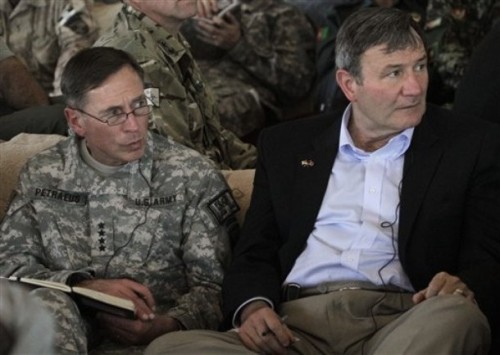
Gen. David Petraeus, left, the top commander of U.S. and NATO forces in Afghanistan, and U.S. Ambassador Karl Eikenberry listen to Afghan President Hamid Karzai as he talks to Afghans in Argandab district of Kandahar province, south of Kabul, Afghanistan, Saturday, Oct. 9, 2010. (GettyImages)


October 09, 2010 (KATAKAMI) --- Afghan President Hamid Karzai and top U.S. General David Petraeus are visiting the southern province of Kandahar, where coalition forces are engaged in a major operation against the Taliban.

U.S. Ambassador Karl Eikenberry also is accompanying the Afghan president, who is expected to meet with tribal elders Saturday to rally support for his government and for international forces.

NATO and Afghan troops are trying to drive the Taliban out of its southern stronghold with a military offensive called Operation Dragon Strike.

In another development, the British Foreign Ministry says a British aid worker kidnapped in Afghanistan was killed by her captors during a rescue attempt.  Linda Norgrove and three Afghan colleagues were abducted September 26 in the eastern province of Kunar.

Foreign Secretary William Hague expressed "deep sadness" in a statement Saturday confirming Norgrove's death.

Also, a spokesman for Italy's Defense Ministry, General Massimo Fogari, says four Italian troops were killed and another was wounded in an attack in western Afghanistan.  He said the soldiers' convoy was first struck by a roadside bomb, before insurgents attacked with gunfire.

Italian Prime Minister Silvio Berlusconi said he was saddened by the "tragic ambush."

Italy has about 3,400 soldiers in Afghanistan, deployed mostly in the west.

On Friday, a bomb blast at a mosque in northern Afghanistan killed 13 people, including the governor of Kunduz, Mohammad Omar, who frequently spoke out against the Taliban and had escaped at least two previous attempts on his life.


VOICE OF AMERICA (VOA)

Oktober 08, 2010

Bomb kills Afghan governor, 15 others-official

(Getty Images)


(KATAKAMI) - A bomb attack inside a mosque killed the governor of Afghanistan's northern Kunduz province and 15 others as they attended Friday prayers, the local police chief said.

The attack on governor Mohammed Omar happened in neighbouring Takhar province, where he had a home. At least 20 people were wounded.

"The situation is chaos, we do not know whether it was a suicide attack or whether the bomb was already planted in the mosque," Shah Jahan Noori, police chief for Takhar province, told Reuters.

It was the most serious attack since parliamentary elections last month, when a wave of assaults killed at least 17 people as the Taliban vowed to disrupt polling.

The war in Afghanistan, now in its tenth year, is at its bloodiest since the 2001 ouster of the Taliban.
The insurgency has spread to northern parts of the country, that until recently were relatively peaceful, from its heartland in the south and east.

Attacks during Friday prayers are relatively rare in Afghanistan. In July, a candidate for parliamentary elections was killed by a bomb planted in a mosque in eastern Khost province.

More than 2,000 foreign troops have been killed since the war began -- over half in the last two years -- and U.S. President Barack Obama and his NATO allies are under pressure at home over the increasingly unpopular war.


REUTERS

Karzai Reaches Out to Taliban in New Afghan Peace Council

Afghan President Hamid Karzai, center, speaks during the inaugural session of Afghanistan's new peace council in Kabul, Afghanistan, 7 Oct. 2010 (AP)


October 08, 2010 (KATAKAMI) --- Afghan President Hamid Karzai used the anniversary of the start of the war in Afghanistan to open the inaugural session of a peace council appointed to help reconcile with the Taliban and other militant groups.

President Karzai offered peace to the Taliban nine years to the day after U.S.-led forces began their effort to topple the group's government in Kabul.

Mr. Karzai opened the 70-member council meeting.

The Afghan leader said he hoped the High Council for Peace will make the desire of peace and stability a reality for the nation. He said Afghanistan's reconstruction and development are linked to peace and stability.
The council includes former Taliban officials as well as past Afghan presidents, civilian and religious leaders.
President Karzai made a special appeal to members of the Taliban in their main language, Pashto.

He called again on opposition forces, the Taliban and any Afghan citizen inside or outside of the country to use the opportunity to forge peace.

The U.S. government has expressed support for Mr. Karzai's long-standing efforts to negotiate peace with the Taliban.

For months, there have been scattered reports that the Karzai administration has been involved in secret talks with the militant group. But the Taliban leadership officially has dismissed the possibility of reconciliation until foreign forces leave the country.

Afghan political analyst Wadir Sapai says he believes that the Taliban will accept a timeline for a coalition withdrawal only if the Afghan government meets its other basic demands, which include government recognition of the Taliban as a legitimate political group with sovereignty within its regional strongholds.
Sapai says the Taliban inadvertently finds itself with allies in the current Afghan government, who are echoing its call for changes to the country's constitution.

"Even the opposition of the present government also wants this amendment, which would be a parliamentary regime with a prime minister and limited authorities for the president," he said.

Sapai says that a lack of trust in the Afghan government contributes to the belief that Afghanistan has lost more than it has gained after nine years of war.

"Afghanistan has lost in the security sphere, in the economic sphere, in the political sphere and also in the nation building," he added. "Afghanistan has not gained anything for society, nothing for the peace [and] nothing for the region."

This year has been the deadliest of the war, with more than 560 foreign troops killed. More than 2,000 foreign troops have died since 2001. As coalition and Afghan forces push deeper into Taliban-controlled territory in the south, analysts warn that the number of causalities will increase.


VOA