Tampilkan postingan dengan label Manmohan Singh. Tampilkan semua postingan

Januari 01, 2011

Let us make a new beginning in the year ahead: PM Manmohan Singh


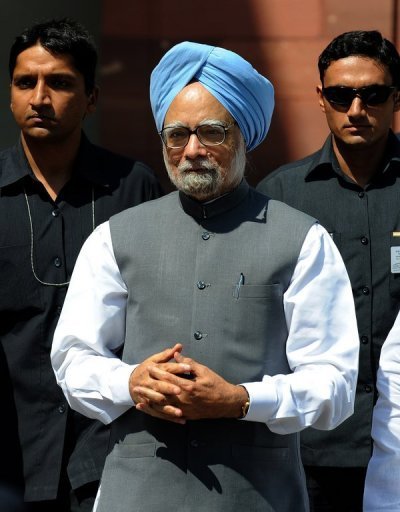
FILE : Prime Minister of India Manmohan Singh
Please also visit : KATAKAMI.COM


January 01, 2011. (KATAKAMI / INDIA TODAY) --- Seeking a "new beginning" in the year ahead, Prime Minister Manmohan Singh on Friday asked people to believe in the resilience of democracy and its capacity to deal with infirmities through course correction.

"Let us make a new beginning to the year. Let us dispel the air of despondency and cynicism," Singh said in his New Year message, assuring people that he and his government would work with renewed resolve for their welfare.

Wishing the people a happy New Year, he said, "We will redouble our efforts to deal effectively and credibly with the challenges of inflation, cleansing our governing processes, national security and making our delivery system work for the aam aadmi.

"We need to believe in the resilience of our democracy and its capacity to deal with infirmities and shortcomings through course correction."

The prime minister said on the eve of the New Year, it is an occasion to take stock of the year gone by and of the challenges that lie ahead.

The government has been on the backfoot in the wake of a series of scandals and the Opposition had paralysed Winter Session of Parliament demanding a JPC to go into the 2G spectrum allocation scam.

There has also been growing concern over rising inflation and prices of essential commodities.

(*)

Oktober 26, 2010

Photostream : Indian Prime Minister Manmohan Singh in Japan

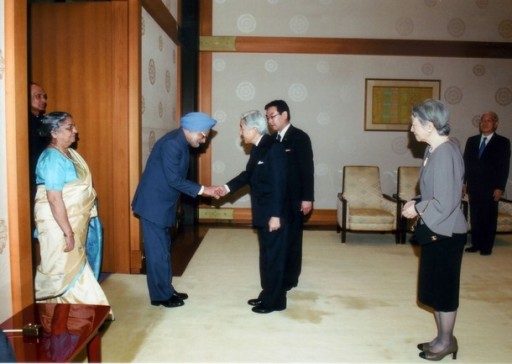
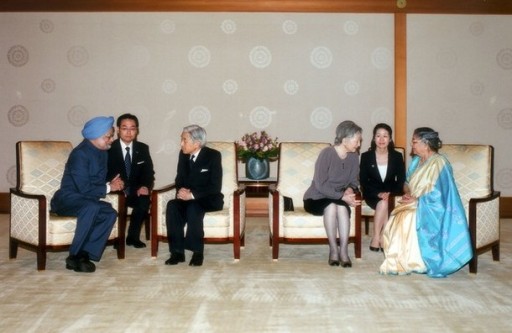
India's Prime Minister Manmohan Singh (2nd L) and his wife Gursharan Kaur meet Japan's Emperor Akihito (4th R) and Empress Michiko (2nd R) at the Imperial Palace in Tokyo October 25, 2010 in this handout photo released by the Imperial Household Agency of Japan. Indian Prime Minister Manmohan Singh on Monday urged closer ties with Japan to bolster Asian economic growth, as Tokyo struggles to offset the risk of its growing dependence on giant rival China. (Getty Images / REUTERS/Imperial Household Agency of Japan/Handout )
India's Prime Minister Manmohan Singh (L) and his wife Gursharan Kaur (R) meets Japan's Emperor Akihito (2nd L) and Empress Michiko at the Imperial Palace in Tokyo October 25, 2010 in this handout photo released by the Imperial Household Agency of Japan. Singh on Monday urged closer ties with Japan to bolster Asian economic growth, as Tokyo struggles to offset the risk of its growing dependence on giant rival China. (REUTERS/Imperial Household Agency of Japan/Handout/ Getty Images)
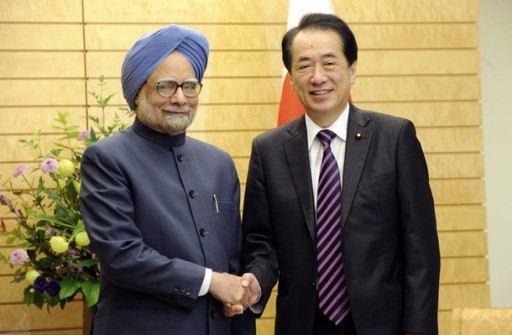
Indian Prime Minister Manmohan Singh (L) shakes hands with Japanese Prime Minister Naoto Kan in Tokyo October 25, 2010. Singh on Monday urged closer ties with Japan to bolster Asian economic growth, as Tokyo struggles to offset the risk of its growing dependence on giant rival China. (Getty Images / REUTERS/Everett Kennedy Brown/Pool )
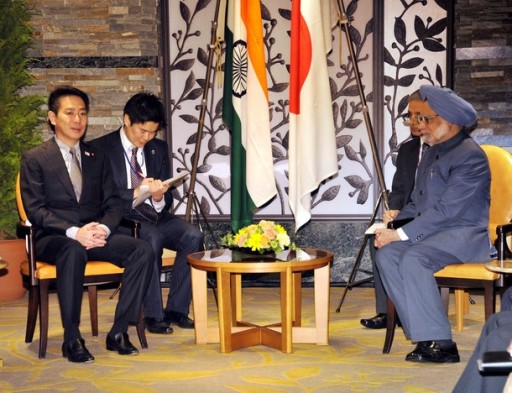
Indian Prime Minister Manmohan Singh (R) talks with Japanese Foreign Minister Seiji Maehara at a Tokyo hotel on October 25, 2010. Singh is on a visit aimed at progressing towards a civilian nuclear deal and boosting trade ties. (Photo : YOSHIKAZU TSUNO/AFP/Getty Images)

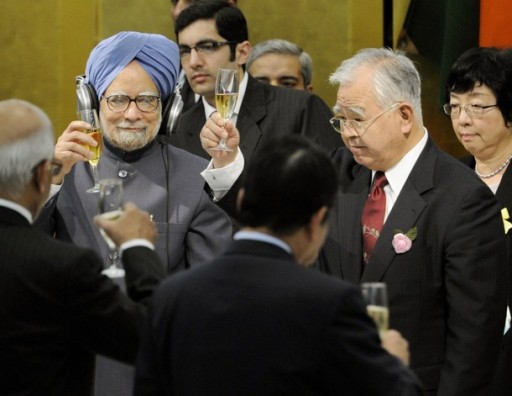
India's Prime Minister Manmohan Singh (2nd L) toasts with the Japan Business Federation (Keidanren) Chairman Hiromasa Yonekura (2nd R) during a luncheon with Japanese business leaders in Tokyo October 25, 2010. (Getty Images)

Oktober 24, 2010

India ready to seal nuclear deal with Japan: PM Manmohan Singh


Indian Prime Minister Manmohan Singh has said Japan's high technology and India's "fast-extending market," if combined, can bring about "mutually beneficial growth opportunities" for both countries.


October 24, 2010 (KATAKAMI / FRANCE24 / AFP) - India is ready to seal a civilian nuclear deal and boost trade ties with Japan, Prime Minister Manmohan Singh said, as New Delhi looks to prove its friendship in the wake of Tokyo's bitter territorial spat with Beijing.

"I am confident that we will be able to conclude an agreement (on a civilian nuclear deal), which will be a win-win proposition for both of us," Singh told a group of Japanese media, before heading to Tokyo to meet his counterpart Naoto Kan on a three-day trip starting Sunday.

Singh said India would like Tokyo to be its partner in nuclear energy, noting that Japan has "one of the highest and most advanced nuclear technologies."

Japan and India launched talks in June on signing an atomic civilian cooperation agreement that will allow Tokyo to export nuclear power generation technology to energy-hungry India.

But Japan, which was hit by World War II US atomic bombings, has warned India that conducting any new nuclear tests would force a halt to any civilian nuclear cooperation with the South Asian giant, as India has developed nuclear arms without signing the Nuclear Non-Proliferation Treaty.

"With regards to tests, we have unilaterally declared a moratorium on explosive testing and we have no intention" of revising that commitment, Singh said in an interview broadcast by NHK.

Singh and Kan were Monday expected to declare the completion of talks on an economic partnership agreement (EPA), which Singh said would open up the fast-growing Indian market to Japanese firms.
"I attach great importance to the potential of the economic cooperation," Singh said. The EPA "will boost our trade and economic ties many-fold."

Japan's expertise in technology and India's "fast-extending market", if combined, can bring about "mutually beneficial growth opportunities" for both countries, Singh said, as quoted by Jiji Press.

Japan has long tried to enhance ties with emerging economies but its relations with China, Asia's other population giant, hit rock bottom in a row following Japan's arrest of a Chinese trawlerman last month in disputed waters.

Beijing reacted angrily to the arrest, cancelling all high level talks and civilian programmes as well as suspending exports of rare earth minerals crucial for Japan's high-tech industries.

India has seized on this blocking of exports as a chance to step into a gap, with Singh saying New Delhi and Tokyo can cooperate on the production of rare earth minerals in India.

"This should be an added incentive for many countries which have a potential to produce rare earths to take advantage of that opportunity," Singh said.

But he added that "It's our sincere hope" that any Japan-China disputes involving maritime activities or maritime boundaries will be "resolved peacefully through diplomatic channels."

Despite frequent diplomatic rows, China has replaced the United States as Japan's top trading partner in recent years, while India only ranks as Japan's 28th biggest trade partner.

India holds three percent of global reserves of rare earth minerals, accounting for two percent of global production, while China accounts for 36 percent of global reserves and 97 percent of global production.
State monopoly Indian Rare Earths Ltd. (IREL) hopes to "attract Japanese businesses to the refining and processing fields to help boost our price competitiveness," the business daily Nikkei reported, quoting an unnamed senior IREL official.

Indian Prime Minister Manmohan Singh leaves for three-nation Asia tour


(FILE) Prime Minister of India Manmohan Singh (Photo by Daniel Berehulak/Getty Images)
October 24, 2010 New Delhi (KATAKAMI / IBNLIVE.IN) : Prime Minister Manmohan Singh on Sunday left for a three-nation tour of Japan, Malaysia and Vietnam to bolster economic ties with partners in East Asia and strengthen India's presence in the region.

The first stop of the weeklong trip is Tokyo, where the prime minister will spend three days for the annual summit meeting with Japan. From the Japanese capital, Manmohan Singh will move to Kuala Lumpur and then to Hanoi, where he will attend the 8th India-Asean and the 5th East Asia Summit.

"The Indian economy is getting increasingly integrated with those of its East Asian partners. PM's three nation tour is organically defined by this process," said Foreign Secretary Nirupama Rao on Friday.

With strengthening economic ties underpinning the weeklong trip, India is expected to announce the conclusion of negotiations on the Comprehensive Economic Partnership Agreement (CEPA) with Japan, the bilateral Comprehensive Economic Cooperaton Agreement (CECA) with Malaysia and deliberate on the Comprehensive Economic Partnership in East Asia (CEPEA) at the 16-nation East Asia summit in Vietnam.

The third leg in Hanoi will see the prime minister hold several bilateral meetings with Asian leaders, including Chinese Premier Wen Jiabao.

The Prime Minister returns home October 30 evening.