November 15, 2010

Prime Minister David Cameron welcomes release of Paul and Rachel Chandler


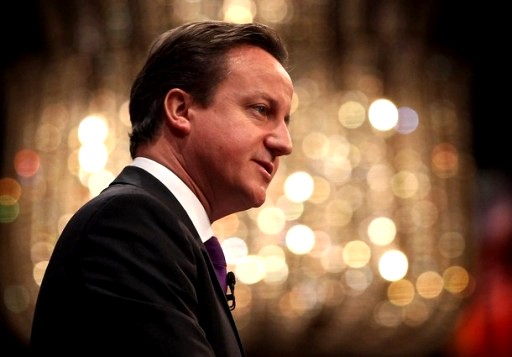
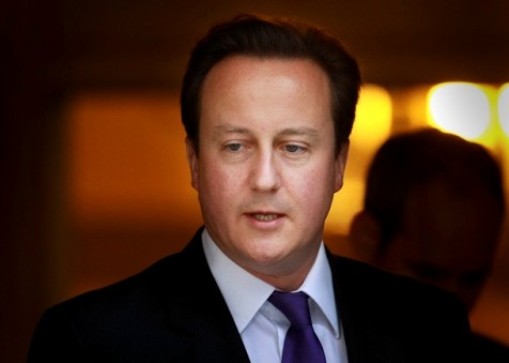
British Prime Minister David Cameron

Please also visit : KATAKAMI.WORDPRESS.COM

November 14, 2010 (KATAKAMI / NUMBER 10.GOV.UK) --- Prime Minister David Cameron has welcomed the release of kidnapping victims Paul and Rachel Chandler.

The Chandlers, from Kent, left Somalia today after more than a year in captivity. They were taken hostage in October last year when their yacht was stormed by armed men.

The PM said:
“Paul and Rachel Chandler’s release is tremendous news. Their long captivity is over at last.
We will ensure that they are reunited with their family as quickly as possible. I unreservedly condemn the actions of those that held the Chandlers for so long. Kidnapping is never justified.
“I am grateful to all those who have worked so hard to bring the Chandlers safely out.”  (*)

After 388 days, Somali pirates free British couple


British sailors Paul and Rachel Chandler, left, talk with a local leader after the two were released from captivity on Sunday, Nov. 14, 2010 in Adado town, Somalia. The British couple kidnapped off their private yacht by Somali pirates more than a year ago were set free Sunday, ending one of the most drawn-out and dramatic hostage situations since the rash of piracy began off East Africa. Pirates boarded the Chandler's 38-foot yacht the night of Oct. 23, 2009, while sailing from the island nation of Seychelles. The couple, married for almost three decades, took early retirement about four years ago and were spending six-month spells at sea (AP)

Please also visit : KATAKAMI.WORDPRES.COM

November 15, 2010 NAIROBI, Kenya (KATAKAMI / AP)  – The retired British couple were sailing the world on a 38-foot-yacht that represented most of their life savings when Somali pirates captured them last year, demanding the sort of huge ransom a multimillionaire or a multinational company might cough up.

The fact that Paul and Rachel Chandler couldn't pay a big ransom helped stretch out their ordeal 388 agonizing days — until Sunday, when they were released thin and exhausted, but smiling. It was one of the longest and most dramatic hostage situations since the Somali piracy boom began several years ago.

The Chandlers were welcomed by the Somali community close to where they had been held, and later met with the Somali prime minister in Mogadishu. A private jet then flew them to Nairobi's military airport, where they were whisked away in a British Embassy vehicle.

"We are happy to be alive, happy to be here, desperate to see our family, and so happy to be amongst decent, everyday people, Somalis, people from anywhere in the world who are not criminals, because we've been a year with criminals and that's not a very nice thing to be doing," Rachel Chandler said at a news conference in Mogadishu.

She also said in a BBC interview that their captors beat them during their captivity after deciding to separate the couple.

"We were really distraught, very frightened at that point," Chandler said. "We refused to be separated and we were beaten as a result. And that was very traumatic."

When asked about their health, she said "we're OK."

Pirates boarded the Chandlers' yacht the night of Oct. 23, 2009, while the couple were sailing from the island nation of Seychelles. The couple, married for almost three decades, took early retirement about four years ago and were spending six-month spells at sea. They had sailed to the Greek islands, Egypt, Sudan, Eritrea, Oman, Yemen, India and the Maldives.

They could not make it through the dangerous waters of East Africa, where pirate attacks have spiked the last several years. Despite an international flotilla of warships and aircraft, pirates continue to prowl the Indian Ocean seemingly at will, pouncing on pleasure craft, fishing vessels and huge cargo ships using small skiffs, automatic weapons and rocket-propelled grenades.

Somali pirates still hold close to 500 hostages and more than 20 vessels. The pirates typically only release hostages for multimillion-dollar ransoms. But unlike the companies who own large transport ships, the Chandlers are far from rich. Paul Chandler has been identified in the British media as a retired construction site manager, while Rachel has been described as an economist.

Pirates had initially sought a $7 million ransom. The Chandler family said in a statement Sunday that during protracted discussions with pirates that it was "a difficult task" to convey that Paul and Rachel were "two retired people on a sailing trip on a small private yacht and not part of a major commercial enterprise."

Repeated efforts to free the couple by the Somali diaspora, the weak Mogadishu-based government and Britain had failed over the last year until, the family said, "common sense finally prevailed." The family said it would not comment on questions about payment to the pirates, so as not to encourage the capture of other private individuals.

Conflicting reports from Somali officials about the Chandlers' release said there was either a $300,000 ransom for "expenses" or a $1 million ransom that the Somali diaspora helped pay. A spokeswoman for Britain's Foreign Office said the ministry wasn't immediately able to comment on the release, but it has always insisted that the British government never pays ransom.

British Prime Minister David Cameron called the Chandlers' release "tremendous news."
"Their long captivity is over at last," he said. "I unreservedly condemn the actions of those that held the Chandlers for so long. Kidnapping is never justified."

The pirates set the couple free about 4 a.m. Sunday, said Mohamed Aden, the leader of the government administration in Adado, a stifling hot region of central Somali near the Ethiopia border. When they arrived in Adado they were taken to a safe house, took a shower and changed clothes. They then took about a 90-minute nap, Aden said. When they awoke they had what he called a "British" breakfast of fried eggs.

The couple attended a ceremony with several dozen people seated in blue plastic chairs. Rachel Chandler wore a bright red dress and red scarf. Paul Chandler wore a mauve-colored short shirt and a green patterned sarong. Both appeared thin, suggesting they ate little while in the control of pirates in a sweltering region near the Ethiopia border.

"The community expressed their sorrow over their captivity and they told them that the pirates don't represent all Somalis but they represent a fringe part of the community," Aden told AP. "The Chandlers thanked the community in return and they said they are grateful for anyone who played a role in their release."

In the Somali capital, the couple walked across the airport tarmac, smiling and thanking people. Paul Chandler had a large camera around his neck and was taking photos.

Somali Prime Minister Mohamed Abdullahi Mohamed met the two and said the government had "exerted every humanly possible effort to bring you back to your loved ones."

Somalia, however, has been without a functioning government since clan-based warlords toppled dictator Mohamed Siad Barre in 1991. Pirates, meanwhile, have made tens of millions of dollars there over the last several years, fueling a building boom in Somali neighborhoods of Nairobi and a spending spree on cars, women and guns in pirate towns.

The Chandlers were to get medical checkups in Nairobi and fly back to Britain shortly afterward. A statement from their family in Britain said that Paul and Rachel were in good spirits although tired and exhausted.

Abdi Mohamed Elmi, a Somali doctor who has regularly attended to the couple and was involved in efforts to free them, said the Chandlers will now need more specialized attention.

"They need counseling and rest to recover from the situation they have been living in for the last 13 months," Elmi said. "But now they seem OK and were happy this morning. They had showers, changed clothes and had breakfast with us smiling."

A serious attempt to free the Chandlers had been made in June, according to a Nairobi-based Western official. Roughly $450,000 was dropped from a plane to free the couple, but pirates had been negotiating with different groups of people, and the effort to free the couple fell through, said the official, spoke on condition of anonymity because of the nature of his work.

International navies have taken a more aggressive approach this year to stop the pirates, and vessels often employ armed, private security on board. But the hijackings have persisted because the sea is so vast, and because piracy offers Somalis high pay in a country where few economic opportunities exist. (*)
Suu Kyi's message to Myanmar's junta: 'Let's meet and talk'


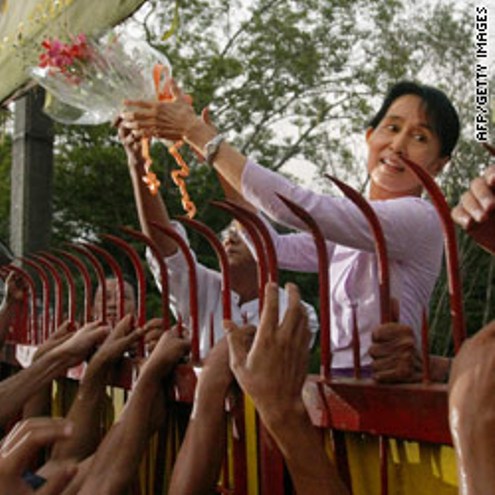
Aung San Suu Kyi holds a sign reading "I love the public too" while addressing supporters outside her National League for Democracy party headquarters in Yangon November 14, 2010. The pro-democracy leader called for freedom of speech in army-ruled Myanmar on Sunday and urged thousands of supporters to stand up for their rights and not lose heart, indicating she might pursue a political role. (Getty Images / REUTERS/Soe Zeya Tun )

Please also visit KATAKAMI.WORDPRES.COM

November 15, 2010 YANGON, Myanmar  (KATAKAMI / NATION.COM.PK) --- – Pro-democracy leader Aung San Suu Kyi called on Sunday for freedom of speech in army-ruled Myanmar, urged thousands of supporters to stand up for their rights, and indicated she may urge the West to end sanctions.

Suu Kyi’s first major speech since being freed from seven years of house arrest a day earlier left little doubt she would resume an influential political role in one of the world’s most isolated and oppressive countries.

“The basis of democratic freedom is freedom of speech,” she said to roaring cheers from thousands of supporters crammed into a cordoned-off street in front of her party’s headquarters. “Even if you are not political, politics will come to you.”
The 65-year-old Nobel peace laureate, who had lost none of her ability to rouse and mesmerize crowds, offered an olive branch to the military junta, saying she had no antagonism for those who kept her detained for 15 of the past 21 years.

Asked by a reporter what message she had for supreme leader Senior General Than Shwe, she replied, “let’s meet and talk.” The two last met in secret talks in 2002 at the encouragement of the United Nations.

Suu Kyi said she bore no grudge against those who had held her in detention for more than 15 of the last 21 years, adding that she had been well-treated.

“I hope they (the military) won’t feel threatened by me. Popularity is something that comes and goes. I don’t think that anyone should feel threatened by it,” she said.

Suu Kyi thanked her well-wishers and asked them to pray for those still imprisoned by the junta. Human rights groups say the government holds more than 2,200 political prisoners.

‘Stand up for what is right’

The address, given in an informal style in contrast to the usual stuffy military speeches that dominate state media, illustrated the strength of Suu Kyi’s pro-democracy voice at a critical time, just a week after an election widely condemned as rigged to prolong military power behind a facade of democracy.

“You have to stand up for what is right,” Suu Kyi added, urging supporters to be more politically assertive in the former British colony formerly known as Burma, where the army controls nearly every facet of life. “A one woman show is not a democracy.”

Later, speaking with reporters, she declined to comment directly on whether she would urge the West to roll back sanctions that many say hurt ordinary people by allowing the junta to monopolize the country’s resource-rich economy.  (*)

Photostream : Remembrance Day 2010 at London's Cenotaph war memorial


Queen Elizabeth II waits to lay a wreath as Princess Anne, Princess Royal, Prince Andrew, Duke of York and Prince Philip, Duke of Edinburgh look on at the Cenotaph during Remembrance Sunday in Whitehall, on November 14, 2010 in London, England. Remembrance Sunday tributes were carried out across the nation to pay respects to all who those who lost their lives in current and past conflicts, including the First and Second World Wars. (Photo by Dan Kitwood/Getty Images)

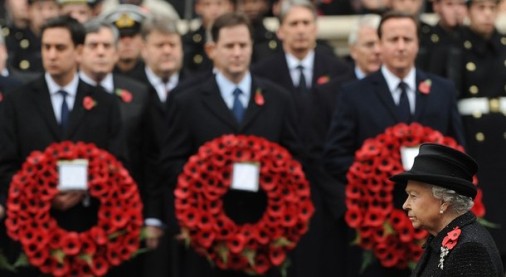
Britain's Queen Elizabeth II (R) walks in front of Britain's Prime Minister, David Cameron (2nd R) Deputy Prime Minister, Nick Clegg (3rd R) and Leader of the Labour Party, Ed Miliband (L) during the Remembrance Sunday service in Whitehall, London, on November 14, 2010. (Photo by BEN STANSALL/AFP/Getty Images)

Britain's Queen Elizabeth II prepares to lay a wreath during the Remembrance Sunday service in Whitehall, London, on November 14, 2010. It marks the armistice to end the First World War. (Photo by BEN STANSALL/AFP/Getty Images)

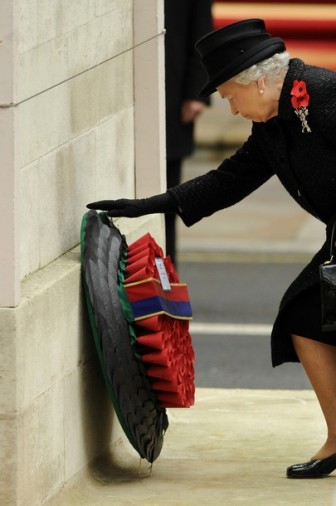
Britain's Queen Elizabeth II lays a wreath on the Cenotaph during the Remembrance Sunday service in Whitehall, London, on November 14, 2010. (Photo by BEN STANSALL/AFP/Getty Images)

Britain's Prime David Cameron (R) and Deputy Prime Minister Nick Clegg attend the annual Remembrance Sunday ceremony at the Cenotaph in Whitehall, in central London November 14, 2010. (Getty Images / REUTERS/Stefan Wermuth )

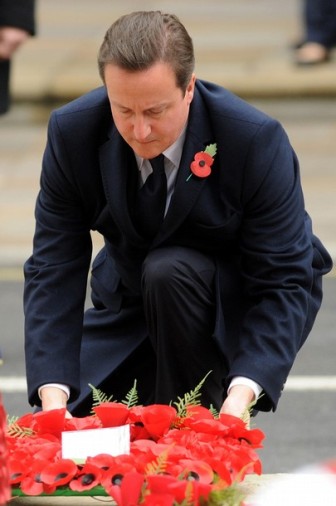
Britain's Prime Minister, David Cameron lays a wreath on the Cenotaph during the Remembrance Sunday service in Whitehall, London, on November 14, 2010. (Photo by BEN STANSALL/AFP/Getty Images)

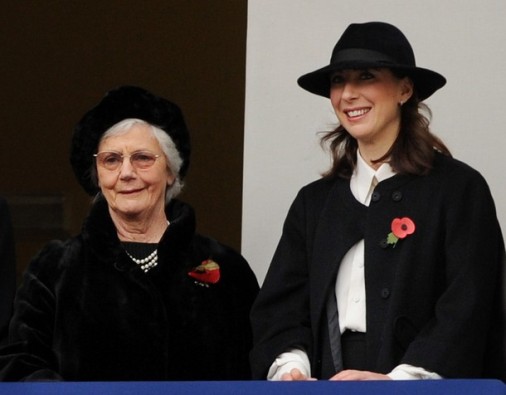
Samantha Cameron (R), wife of British Prime Minister David Cameron (not pictured) and his mother Mary Cameron (L) attend the Remembrance Sunday service in Whitehall, London, on November 14, 2010. (Photo by BEN STANSALL/AFP/Getty Images)

November 14, 2010

Photostream : Russian Prime Minister Vladimir Putin visits Bulgaria


Bulgaria's Prime Minister Boiko Borisov, left, and his Russian counterpart Vladimir Putin lighting candles during their visit in golden-domed "Alexander Nevski" cathedral in Sofia, Saturday, Nov. 13 2010. Putin is in Bulgaria on a one day working visit. (Getty Images / AP Photo/ Bulgarian Government Press Office/Handout)

Bulgaria's Prime Minister Boiko Borisov (L) and his Russian counterpart Vladimir Putin look at a box containing bones, believed to be the relics of John the Baptist, during their visit in golden-domed "Alexander Nevski" cathedral in Sofia November 13, 2010. Putin is in Bulgaria on a one day working visit. Bulgaria's main Orthodox cathedral displayed on Friday jaw and arm bones and a tooth said to be relics of John the Baptist. (Getty Images / REUTERS / Bulgarian Government Press Office/Handout )

Russia's Prime Minister Vladimir Putin kisses a religious icon as he visits the Alexander Nevsky cathedral in Sofia, November 13, 2010. Putin is in Bulgaria on a one day working visit. (Getty Images / REUTERS / Alexey Nikolsky / Ria Novosti/Pool )Bulgaria's President Georgi Parvanov (R) and Russia's Prime Minister Vladimir Putin greet before their meeting in Sofia November 13, 2010. (Getty Images / REUTERS/Stoyan Nenov )

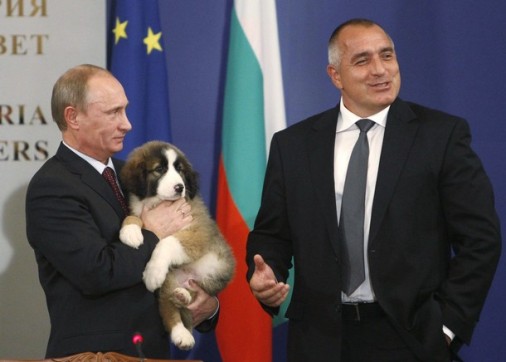
Bulgaria's Prime Minister Boiko Borisov reacts as Russia's Prime Minister Vladimir Putin (L) hugs a Bulgarian shepherd dog presented by Borisov as a gift in Sofia, November 13, 2010. Putin is in Bulgaria on one day working visit. (Getty Images / REUTERS / Oleg Popov )

Russian Prime Minister Vladimir Putin hugs a Bulgarian shepherd dog, a present from his Bulgarian counterpart Boyko Borisov after their press conference in Sofia on November 13, 2010. Bulgaria's state energy holding BEH and Russian gas giant Gazprom set up on Saturday a joint venture to build and operate the Bulgarian stretch of the South Stream gas pipeline from Russia to southern Europe. (Getty Images / AFP PHOTO / NIKOLAY DOYCHINOV )

Russia to host APEC summit on September 8-9, 2012

Russia's President Dmitry Medvedev

Please also visit : KATAKAMI.WORDPRESS.COM

November 14, 2010 (KATAKAMI / RIA NOVOSTI) — Russia will host the Asia-Pacific Economic Cooperation (APEC) summit on September 8-9, 2012, a source in the APEC secretariat said on Sunday.

“Russian President Dmitry Medvedev said at a working meeting of the APEC forum today that Russia will host the summit on the Russian Island on September 8-9, 2012,” the official said.  (*)


YOKOGAMA, November 14

PM Netanyahu asks ministers to back 90-day settlement freeze


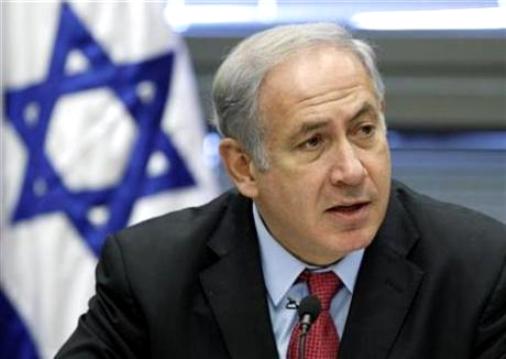
Israeli Prime Minister Benjamin Netanyahu

Please also visit : KATAKAMI.WORDPRESS.COM

November 14, 2010 (KATAKAMI / YNET) — Netanyahu convenes top government ministers for late-night session on American proposal, asks them to approve construction moratorium in West Bank in exchange for US veto on anti-Israel initiatives in UN.

The forum of top seven government ministers convened Saturday night at the Prime Minister’s Office in Jerusalem to discuss the latest American proposal for renewing direct talks between Israel and the Palestinians. 

Just a month after he vowed that construction in the West Bank would continue until the Palestinian Authority recognizes Israel as a Jewish state, Prime Minister Benjamin Netanyahu asked his ministers to approve a 90-day settlement construction freeze. 

Netanyahu apparently succumbed to the ongoing US pressure following a lengthy meeting with Secretary of State Hillary Clinton.

The US proposal presented to the ministers is premised on a construction moratorium extension for another three months. PM Netanyahu apparently reached an understanding with Washington that the building freeze would not apply to Jerusalem, and that no further moratorium would be sought following the 90-day period. 

Earlier Saturday, a close associate of PM Netanyahu hinted at the proposal, declaring that he wouldn’t “bet on a full freeze” extension to be implemented.

20 advanced fighter jets

In exchange for a freeze extension, the US would object to international attempts to force a diplomatic agreement on Israel in the UN and in other global forums, while utilizing the American veto power in the UN Security Council. 

According to the proposal, the US would also boost its resistance to the de-legitimization campaign against Israel and to attempts by Arab states to deprive Israel’s right to self-defense.

Moreover, the US Administration would ask Congress to approve the sale of another 20 advanced fighter jets to Israel worth some $3 billion. This would supplement a comprehensive future Israeli-American security agreement, to be signed alongside a peace deal, in the aims of addressing Israel’s security needs in any future treaty. (*)

U.K. Foreign Secretary urges Palestinians to rejoin peace talks


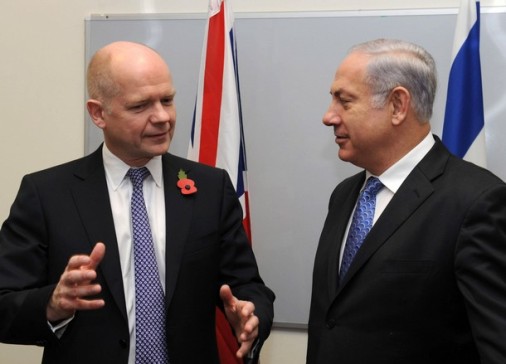
Israeli PM Benyamin Netanyau meets British Foreign Minister William Hague on November 4, 2010 in Tel Aviv, Israel. Willian Hague is on a two-day official visit to Israel his first as foreign secretary. Diplomatic tension rose after a high-level security and defence meeting was cancelled on November 3, 2010 due to a row over universal jurisdiction legislation in the UK. (Photo Moshe Milner/GPO/Getty Images)

Please also visit : KATAKAMI.BLOGSPOT.COM

November 13, 2010 (KATAKAMI / HAARETZ) --- Ahead of trip to U.S. next week, William Hague calls on Mahmoud Abbas to return to stalled Israeli-Palestinian peace talks as soon as possible.

British Foreign Secretary William Hague has urged Palestinians to rejoin Middle East peace talks, before discussions in the U.S. next week. 

Hague said he told Palestinian President Mahmoud Abbas in a phone call on Saturday that he was disappointed by Israeli plans to build new Jewish homes in East Jerusalem. 

But he urged Abbas to return to the stalled talks as soon as possible. He said he would discuss the situation with U.S. Secretary of State Hilary Clinton during a visit to Washington next week. 

U.S.-sponsored direct Israeli-Palestinian peace talks broke down on September 26 when a 10-month Israeli freeze on West Bank settlement construction expired. Abbas has said he would not conduct peace talks with Israel while settlement construction is taking place. 

Earlier this month, Hague visited Israel and the Palestinian territories in his first visit to the region since taking office in May. (*)

U.K. Foreign Secretary Statement on Aung San Suu Kyi’s release

Please also visit : KATAKAMI.WORDPRESS.COM
November 13, 2010 (KATAKAMI / FCO.GOV.UK) --- "Daw Aung San Suu Kyi's arbitary detention for most of the last 20 years has been deeply unjust. Her fortitude in the face of this outrage has been inspirational."
"I welcome news of her release.  She must now be allowed to assume a role of her choosing in the political life of her country without further hindrance or restriction."

"Last week's sham elections will not bring peace and prosperity to Burma.  The regime now needs to release the other 2,100 political prisoners and begin a genuine dialogue with Aung San Suu Kyi and all opposition and ethnic groups.  These remain the crucial first steps to solving Burma's many problems and addressing the pressing needs of its people."  (*)

British Prime Minister David Cameron has welcomed the release of Aung San Suu Kyi


British Prime Minister David Cameron

Please also visit : KATAKAMI.WORDPRESS.COM

November 13, 2010 (KATAKAMI / NUMBER 10.GOV.UK) --- The Nobel Peace Prize winner has been detained for 15 of the past 21 years.

The PM said:
“This is long overdue. Aung San Suu Kyi is an inspiration for all of us who believe in freedom of speech, democracy and human rights.
Her detention was a travesty, designed only to silence the voice of the Burmese people.
Freedom is Aung San Suu Kyi’s right. The Burmese regime must now uphold it.”  (*)

Bulgarian prime minister adds puppy to Putin's pet collection


Bulgarian prime minister adds puppy to Putin's pet collection
Please also visit : KATAKAMI.WORDPRESS.COM

November 13, 2010 (KATAKAMI / RIA NOVOSTI) --- A fluffy puppy was added to Russian Prime Minister Vladimir Putin's menagerie after talks with Bulgarian Premier Boyko Borisov on Saturday in Sofia.

Borisov gave Russia's "man of action" a Bulgarian Karakachan puppy after sealing a gas deal. Putin accepted the new family member, hugging it close to his chest and kissing it on its nose.

A Siberian tiger cub was given to Putin for his 56th birthday two years ago. The young tigress, named Mashenka, lives in a zoo.

His most famous pet, however, still remains his Labrador Connie, given to him when he was president by Russian Emergencies Minister Sergei Shoigu on New Year's Eve in 2001. Some people say this is the reason why Shoigu is still in his job.

He is also the owner of a cat (who is reported to be living within the Kremlin walls), two poodles, one she-goat and her offspring given by former Moscow Mayor Yury Luzhkov (some people say it's the reason why he lost his job).

The Russian premier, though, seems to like horses most of all: shots of a horse-riding Rambo-like Putin emerge in media outlets every now and again.

Last but not least, the former KGB agent is also in possession of two rare creatures: a Persian gazelle given to him by Kazakh President Nursultan Nazarbayev in 2002 and named Vlada after Putin; and a crystal crocodile given by former Moldovan President Vladimir Voronin in the same year.

"The crocodile is the only animal that doesn't back off," Voronin famously said.

MOSCOW, November 13

Israel's Netanyahu unveils U.S. plan for new talks


Israel's Prime Minister Benjamin Netanyahu speaks during a Likud party meeting at parliament in Jerusalem October 25, 2010.
Please also visit : KATAKAMI.WORDPRESS.COM
 

November 13, 2010 (KATAKAMI / Reuters) - Prime Minister Benjamin Netanyahu showed senior ministers a U.S. plan for resuming peace talks with Palestinians, including a 90-day settlement freeze, a diplomatic source told reporters Saturday.


The plan also includes a pledge not to seek any extension to the settlement freeze after the 90-day period, a vow to veto any attempts at the United Nations to force a unilateral peace deal and an agreement on supplying Israel with more war planes.

Israeli-Palestinian peace talks, renewed under Washington's sponsorship on September 2, broke down a few weeks later when Israel balked at renewing a settlement moratorium.

Netanyahu met his top "Forum of Seven" ministers a day after returning from a week-long U.S. tour that included talks on Thursday with Secretary of State Hillary Clinton at which she unveiled the plan he showed his cabinet, the source said.

Netanyahu hopes he may win approval for the plan from his pro-settler cabinet later this week, political sources said.

Among the pledges offered to Israel by Washington, was a guarantee to veto any resolutions brought to the United Nations Security Council that seek "to impose a political settlement on Israel," the source said, speaking on condition of anonymity.

Palestinian President Mahmoud Abbas had no immediate comment. Officials speaking on condition of anonymity said the Palestinian leader was likely to wait to see whether Israel approved the ideas before issuing any comment.

AN ADDITIONAL FREEZE

Under the plan Israel would "declare an additional suspension of construction" in the West Bank, land it captured from Jordan in a 1967 war, for 90 days. Building begun since a moratorium ended in September, would be halted, the source said.

The proposed construction freeze would not include East Jerusalem, an area Israel has annexed as part of its capital in a move never recognized internationally and which Palestinians want as capital of any future state.

Washington would also undertake to veto resolutions deemed anti-Israel in the U.N. Security Council and other international organizations, the source said, a pledge that could make Israel less vulnerable to threats made by some Palestinians to declare statehood unilaterally in the event that peace talks fail.

The Obama Administration would also ask Congress to approve the supply of $3 billion worth of warplanes to Israel "to maintain its qualitative edge" in the region, the source said.

The United States would further sign a more comprehensive deal to enhance its substantial security aid to Israel as part of any agreement concluded with the Palestinians.

Israeli officials said Netanyahu, who faces a tough political sell within his own coalition on the settlement issue, had pushed Clinton for the broad understandings.

"The chances of reaching a peace agreement will be improved significantly by achieving comprehensive security understandings between Israel and the United States," Netanyahu said in New York before his talks with Clinton began. (*)

Netanyahu associate: Don't bet on full freeze


Israeli PM Benyamin Netanyahu (R) meets U.S. Vice President Joe Biden on November 7, 2010 in New Orleans, Louisiana. Netanyahu is on a five day visit to the U.S. to discuss the ongoing Mideast peace process. (Photo Avi Ohayon/GPO via Getty Images)

Please also visit : KATAKAMI.WORDPRESS.COM

Top seven government ministers scheduled to convene Saturday night, hear about PM's meeting with Clinton.

November 13, 2010 (KATAKAMI / YNET) --- Prime Minister Benjamin Netanyahu was scheduled to convene the forum of top seven ministers Saturday night in order to present US proposals and agreements secured during his meeting with Secretary of State Hillary Clinton.

The US is pressing Israel to resume direct talks with the Palestinians and extend the settlement freeze, yet a Netanyahu associate said "I won't bet on a full freeze."  


Following the US midterm elections, Administration officials have renewed the pressure on Israel, but for the time being Netanyahu has refused to extend the building moratorium.

The PM is arguing that recent construction permits issued in the territories would not affect a future peace deal.

Over the weekend, a senior opposition official told Ynet that despite rumors about progress during talks with the Americans, "Netanyahu did not finalize any agreement with us and did not engage in any negotiations in order to ensure the coalition's stability." 


A senior government official closely familiar with peace contacts told Ynet that "it's not at all certain that we'll see a breakthrough vis-à-vis the Americans – the more things progress, the more complex they become."
 
Elsewhere, the Peace Now movement is saying that the pace of construction in the territories since the end of the freeze is higher than previously reported. The group said it registered construction work on 1,649 housing units, with infrastructure already built for 1,126 such units.  

According to Peace Now, in the past month and a half the settlers almost closed the construction gap created by the freeze, and that most construction is being undertaken in isolated, relatively small settlements.   (*)

U.S. offers Israel incentives package in exchange for 3 month settlement freeze


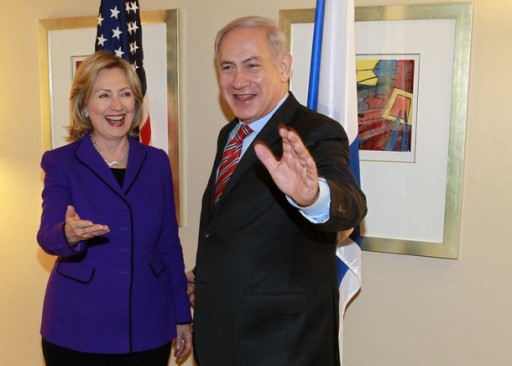
U.S. Secretary of State Hillary Rodham Clinton (L) and Israeli Prime Minister Benjamin Netanyahu pose for photographers before their meeting in New York, November 11, 2010. Getty Images / REUTERS / Brendan McDermid

Please also visit : KATAKAMI.WORDPRESS.COM

Security cabinet meets on Saturday night, receives update from Prime Minister Benjamin Netanyahu on proposed U.S. incentives package.

November 13, 2010 (KATAKAMI / HAARETZ) --- Prime Minister Benjamin Netanyahu's seven-member inner cabinet will discuss Saturday an offer by the United States to reinstate a freeze on West Bank Settlement construction in return for a package of incentives.

Netanyahu presented Saturday the U.S. offer, which was discussed by Netanyahu and U.S. Secretary of State Hillary Clinton on Thursday, to the forum of seven.

According to the offer Israel would stop construction in the West Bank for 90 days. The freeze includes construction that began after the end of the first settlement moratorium on September 26.

The moratorium would not apply to construction in East Jerusalem. The U.S. will not ask Israel to extend the new moratorium when it expires.

In return, the U.S. government would ask Congress to authorize the delivery of 20 F-35 fighter jets to Israel, a deal worth $3 billion. Moreover, if an Israeli-Palestinian agreement is achieved, the U.S. would sign a comprehensive security agreement with Israel. The U.S. and Israel are to discuss the nature of the new security arrangements in the next few weeks.

According to "The Cable" blog, White House Middle East adviser Dan Shapiro told a group of American Jewish leaders on Friday that the incentives package includes commitments to oppose anti-Israel diplomatic efforts in the international arena.

The U.S. incentives package would also include: curbing actions by the United Nations on the Goldstone Report; blocking anti-Israel UN resolutions concerning the Gaza flotilla raid; defeating international resolutions aimed at exposing Israel's nuclear program at the International Atomic Energy Agency; and strengthening pressure on Iran and Syria in regards to their nuclear and proliferation activities.

U.S.-sponsored direct peace talks between Israel and the Palestinian Authority broke down on September 26 when a 10-month Israeli freeze on settlement construction in the West Bank expired. Palestinian Authority President Mahmoud Abbas has said he would not restart negotiations with Israel while settlement construction continues. (*)

November 13, 2010

Dmitry Medvedev met with Naoto Kan on the sidelines of the APEC Summit


Russian - Japanese Talks
November 13, 2010 (KATAKAMI / KREMLIN.RU) --- The leaders of Russia and Japan stated their commitment to developing a dialogue based on trust between the two countries. 

One of the main subjects under discussion was the Kuril Islands." to visit any Russian region, including the Far East, and the Japanese Prime Minister accepted the invitation.


* * *


PRIME MINISTER OF JAPAN NAOTO KAN (retranslated): Mr President, as you pointed out, the Asia-Pacific region is the centre of global economic development. The region has the highest economic growth rate in the world.

I would like to deepen the friendly relations based on partnership and trust between Japan and Russia and will make every effort to achieve this aim. This is our second meeting and I hope that today’s talks will mark the beginning of a full-scale dialogue between us based on mutual trust.

PRESIDENT OF RUSSIA DMITRY MEDVEDEV : Mr Prime Minister, first of all, I would like to thank you once again for the excellent organisation of the APEC Summit. This is indeed our second meeting and I hope that during these talks and in the course of other contacts we will lay the foundation for a dialogue based on trust between our states. (*)